
We can see real-life examples of supplementary angles everywhere, in our house, school, office, on roads, etc. Before proceeding with this, you should know the definition of supplementary angles.
What are supplementary angles?
A pair of angles that add up to exactly 180° is called a pair of supplementary angles. In other words, two angles are supplementary if their sum is 180°.
For example, 120° + 60° =180°
These angles don’t need to be side by side; they can also be separate but still sum up to 180°.
If one angle is known, then the other can be found by subtracting from 180°.
Why supplementary angles matter in everyday life
Supplementary angles matter in daily life because they form stability and balance in every structure and design. It applies from architecture and engineering to sports. They are not only a mathematical concept but are also used in practical life.
Related Topics:
You can also learn about other types of angles from the following topics.
Real-life examples of right angles
Real-life examples of acute angles
Real-life examples of obtuse angles
Real-life examples of a complete angle
Common real-life examples of supplementary angles
The examples of supplementary angles in real life can be seen everywhere, whether you notice or not. Here is a list of real-life examples of supplementary angles that are practical and visual. We will discuss the daily life gadgets that use supplementary angles in their structure.
Supplementary angles are not just a term in mathematics; they are also the foundation of design in architecture. Let’s see practical examples of supplementary angles.
- Stability of the structure:
In a beam, which is responsible for the balance in a design, the angles are supplementary.
- Roof Design:
For the channel of rainwater from the roof, the angles used are supplementary. These angles are used in the form of slopes.
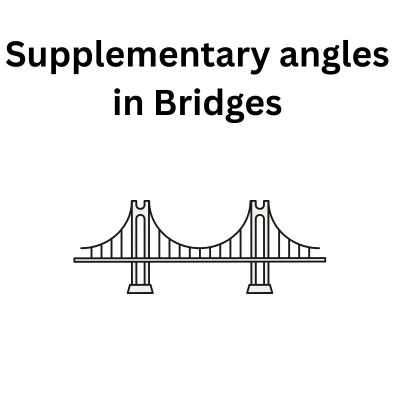
- Supplementary angles in Bridges:
In the construction of bridges, the angle between the cables and beams is supplementary. It forms a balance in the bridges.
- Supplementary angles in Interior Design:
Although these angles are the basis of the main structure sites, these angles are also used in the interior design of our homes, schools, offices, etc.
In staircase design, doors, windows, floor tiles, and ceiling design mostly use supplementary angles.
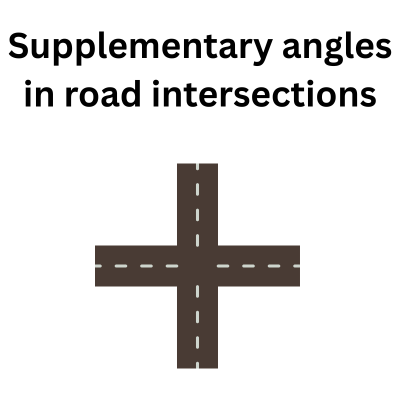
- Supplementary angles in road intersections:
When two roads meet in a straight line, this is also an example of a straight line.
Except for this, if one angle of a road is 100° and the other angle is 80°, then these angles are also supplementary.
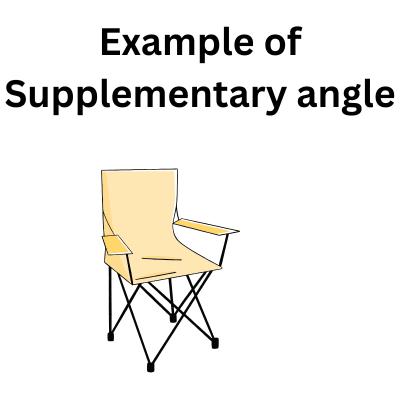
- Folding Chair:
A folding chair is a common real-life example of these angles. If the seat of a chair forms a 70° angle and the backrest forms a 110° angle, then they add up to 180°.
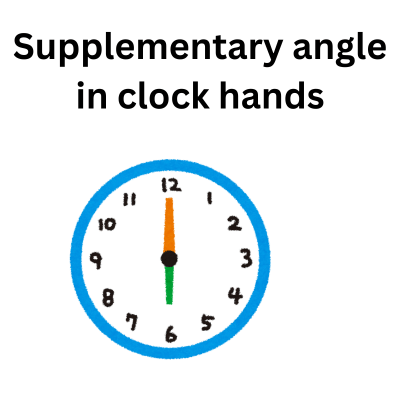
- Clock Hands:
A time of 6 o’clock is shown as an example of supplementary angles. When one hand is at 6 and the other is at 12, the angle formed is a straight line.
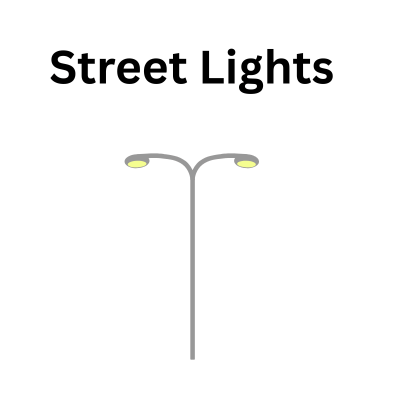
- Street Lights:
Street lights form a straight line, which includes supplementary angles.
- Tennis Court Lines
The extended baseline creates supplementary angles with the sidelines.
- Gym Equipment:
In the gym, the cables form a straight bar between the weight machine and the pulleys.
Conclusion:
Supplementary angles are part of mathematical concepts, but they are also useful in daily life. Real-life examples of supplementary angles can be seen in bridges, roads, room furniture, and interior design.
You can also check supplementary angles on Wikipedia.
FAQ’s:
- What are supplementary angles in simple words?
The angles whose sum is 180° are called supplementary angles.
- Can supplementary angles be non-adjacent?
Yes, these angles don’t need to share a vertex or meet side by side. The important thing is that the sum should be 180°.
- Where are supplementary angles used in real life?
We can see examples in bridges, roads, street lights, room furniture, and many other things.
- How can the missing angle of supplementary angles be found?
By subtracting the known angle from 180°, the missing angle can be found.
- Why are supplementary angles important?
They are important because they are responsible for the structure and balance in architecture, design, or engineering.

I’m a graduate in mathematics. And I’m here to help students with mathematics on different topics.