
Many students often get confused when they see geometric shapes with missing angles. Firstly, these types of shapes may look difficult. But if you follow the angle rules to find the missing angles in a shape, it will become easy for you. In this article, you will find straightforward tricks, step-by-step examples, and thinking processes for how to find the missing angle in a shape.
Moreover, you can also check the whole section about angles for more information.
What are the missing angles in a shape?
In any image, there are different lines and angles. If you know some angles, but a few angles are unknown, then these angles are called the “missing angles” in a shape.
For example, if one angle on a straight line is 45°, you can use the straight-line angle rule to calculate the missing angle.
Many angle rules will help to find missing angles.
Why are angle rules important?
Angle rules depend upon visual thinking and diagrams. Students solve questions in a hurry and don’t pay attention to the diagrams. Angle rules help memorize and understand the angles in a shape. Other than this, angle rules are also used in architecture, roads, different designs, etc.
Basic Angle Rules:
Different angles and rules for different shapes will help when you struggle with the missing angles in a given shape. Here are some basic rules.
- Rule for Straight Line
Straight line angles add up to 180°.
For example, if you’ve been given one angle (a) of a straight line, you can find the other angle (b) by using this formula
a + b = 180°
- Rule for the Point:
Angles around any point add up to 360°.
a + b + c + d = 360°
- Angle Rule for the Triangle:
In any triangle, the angles add up to 180°. For example, there are three angles like a, b, and c; then the rule is:
a + b + c = 180°
- Rule for the Quadrilateral:
Angles in a quadrilateral add up to 360°.
How to Find the Missing Angle in a Shape:
In this section, we will explain the method that will help you find angles step by step.
- Identify the Diagram
- Use the correct angle rule according to the shape
- Form the equation
- Solve the equation carefully
Examples of Finding Missing Angles in Different Shapes:
In this part of the text, we will see examples for each type of shape on how to find the missing angle in a shape step by step. After this topic, you can find the missing angle very easily.
Missing Angles in a Triangle:
Q1. A triangle has two angles:
- 50°
- 60°
Find the missing angle.
Solution:
We will use the triangle rule (a + b + c = 180°).
Here, a = 50°, b = 60°, and c = ?
a + b + c = 180°
50° + 60° + c = 180°
110° + c = 180°
c = 180° – 110°
c = 70°
Q2. An isosceles triangle has
- one angle = 40°
- Two equal angles
Find the equal angles.
Solution:
Let the unknown angle be x.
Using the triangle angle rule.
(a + b + c = 180°).
Here, a = 40°, b = c = x =?
a + b + c = 180°
40° + x + x = 180°
40° + 2x = 180°
2x = 180° – 40°
2x = 140°
x = 140° / 2
x = 70°

Q3. In a triangle, there are 70°, 50°, and x. Find x.
Solution:
Since triangle angles equal 180° (i.e., a + b + c = 180°).
Here, a = 70°, b = 50°, and c = ?
a + b + c = 180°
70° + 50° + c = 180°
120° + c = 180°
c = 180° – 120°
c = 60°
Missing Angles in a Quadrilateral:
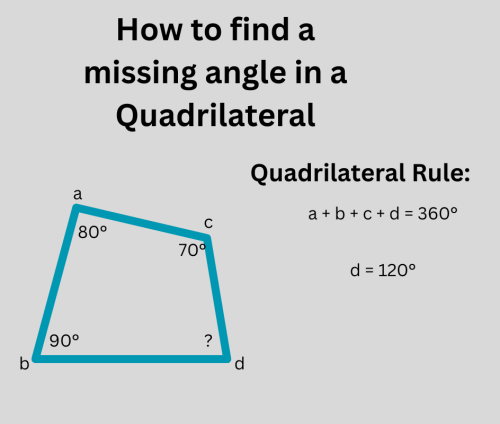
Q1. The angles are
- 90°
- 80°
- 70°
Find the missing angle.
Solution:
We know that in a quadrilateral,
a + b + c + d = 360°
Here, a = 90°, b = 80°, c = 70°, d = ?
a + b + c + d = 360°
90° + 80° + 70° + d = 360°
240° + d = 360°
d = 360° – 240°
d = 120°
Q2. Angles are
- x
- 100°
- 90°
- 80°
Find x.
Solution:
By using the sum of angles in a quadrilateral
a + b + c + d = 360°
Here, a = x, b = 100°, c = 90°, d = 80°
a + b + c + d = 360°
x + 100° + 90° + 80° = 360°
270° + x = 360°
x = 360° – 270°
x = 90°
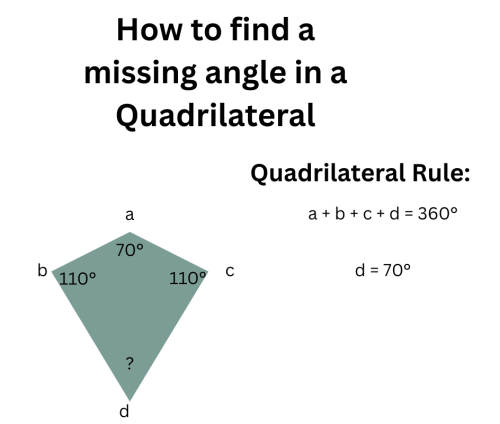
Q3. In a kite, the angles are 110°, 110°, 70°
Find the fourth angle.
Solution:
Using the sum of angles in a quadrilateral
a + b + c + d = 360°
Here, a = 110°, b = 110°, c = 70°, d = x
a + b + c + d = 360°
110° + 110° + 70° + x = 360°
290° + x = 360°
x = 360° – 290°
x = 70°
Missing Angles on Parallel Lines:
Q1. One angle is 40°. Find the corresponding angle.
Solution:
We know that the corresponding angles are equal. So the missing angle is also 40°.
Q2. One alternate angle is 65°. Find the other one.
Solution:
Alternate angles are equal. So the other angle is also 65°.
Q3. One angle is 115°.
Find the co-interior angle.
Solution:
Let the missing angle be x. We know that the co-interior angles add up to 180°.
So,
x + 115° = 180°
x = 180°- 115°
x = 65°
Practice Questions for Beginners:
Here are some questions given for your practice so that you can grasp the missing angle problems. After these practice questions, this topic will become easy for you. Solve these questions using the hints that are given, and then match them with the correct answer.
Q1. One angle on a straight line is 140°. Find the other angle.
(Answer = 40°)
Q2. A regular polygon has an exterior angle of 40°. Find the interior angle.
(Hint: Interior and exterior angles add up to 180°.)
(Answer = 140°)
Q3. One angle is 48°. Find the vertically opposite angle.
(Answer = 48°)
Q4. Three angles of a rectangle are 90°. Find the fourth angle.
(Hint: All rectangle angles are equal.)
(Answer = 90°)
Q5. A triangle has
- 95°
- 35°
Find the third angle.
(Answer = 50°)
For a better understanding, please visit the Wikipedia page on angles.
Mistakes Students Make:
- Many students forget the total angle sum.
- Sometimes, they use the wrong angle rule.
- Students solve questions in a hurry.
- They mix up complementary and supplementary angles.
- They make mistakes when forming an equation.
FAQs:
Q1. How do you find the missing angle?
First, identify the diagram and apply the angle rule according to the diagram.
Q2. What is the formula for missing angles?
There is no specific formula. Different formulas are used for different diagrams.
Q3. Do all triangles equal 180 degrees?
Yes, the interior angles of every triangle always add up to 180°. This rule applies to all types of triangles, including equilateral, isosceles, and scalene triangles.
Q4. Why Are Angle Rules Important in Geometry?
These rules make geometry problems easier to solve and improve visual thinking skills.
Conclusion:
In this section, all angle rules for how to find the missing angle in a shape are described to help students. After reading this article, you will be able to solve questions related to angles.

I’m a graduate in mathematics. And I’m here to help students with mathematics on different topics.