
Examples of Vertical Angles in Daily Life
Vertical angles are found almost everywhere; one simply needs to recognize them. When two straight lines intersect, they form equal and opposite angles known as vertical angles. Examples include the blades of scissors, roads intersecting in an ‘X’ shape, and railway crossings. In this section, we will explore what vertical angles are, how they are formed, where they are found, their importance in daily life, and real-world examples of their use.
What Are Vertical Angles?
A pair of non-adjacent and opposite angles formed when two straight lines intersect is called a pair of vertical angles. Vertical angles are congruent when two straight lines intersect.
Key facts
- Both angles have the same vertex, which is the point where the two lines cross.
- The measurement of both angles is equal, meaning they are congruent angles.
- These are not adjacent angles, meaning they do not share a common side.
Why Do Vertical Angles Matter in Real Life?
Vertical angles aren’t just limited to geometry. They’re also widely used in tools and systems in our daily lives.
Daily Life Uses of Vertical Angles
Engineering and Construction
These angles are used to ensure stable alignment and equal angles in frameworks and intersections.
Transportation Design
Whether it’s at railway junctions or road crossings, vertical angles are used for proper alignment.
Tools and Mechanisms
Movement in everyday tools like scissors, pliers, and folding ladders is achieved with the help of vertical angles.
Surveying and Navigation
By measuring one angle at an intersection, the opposite vertical angle can be determined without measuring again.
What are Some Real-Life Examples of Vertical Angles?
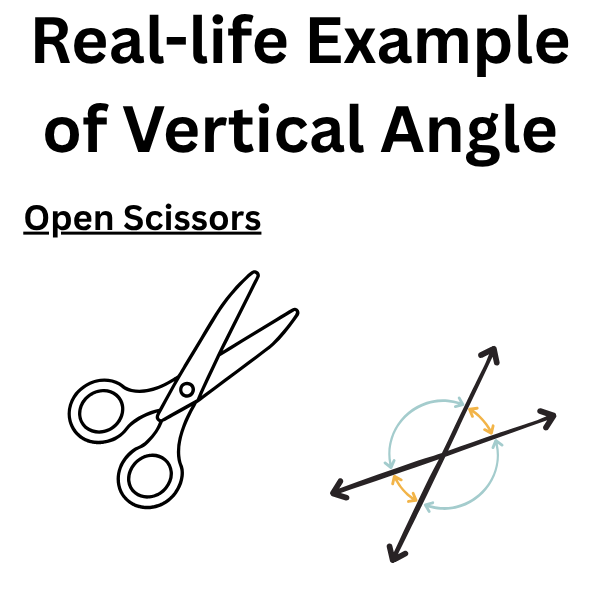
- Open Scissors
Scissors are the most common example of vertical angles. The pivot point of scissors is the vertex. The angles above and below the pivot are called vertical angles. These angles are equal and help balance the cutting edge.
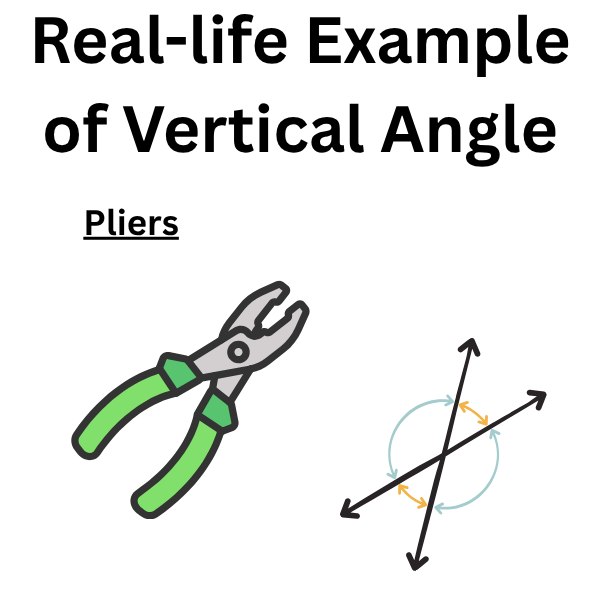
- Pliers
Like scissors, the handles and jaws of pliers and garden clippers intersect at a pivot point, which is the vertex, and this creates a pair of vertical angles.
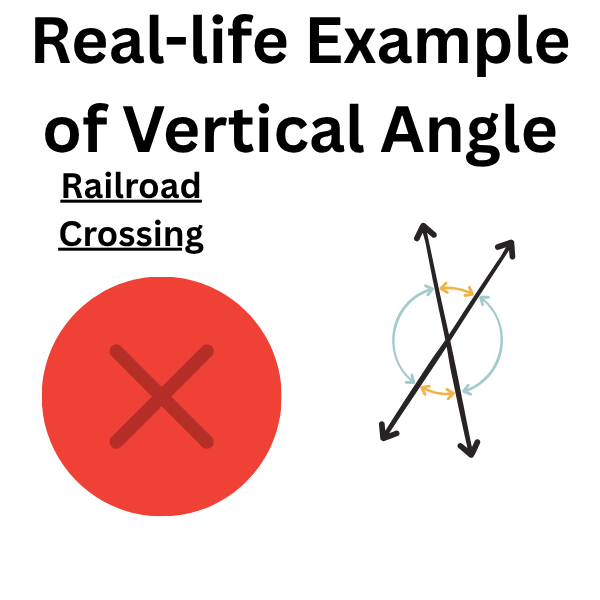
- Railroad crossings
When two railway lines cross each other in a diagonal shape, a pair of vertical angles is formed. These angles are useful for railway track alignment.
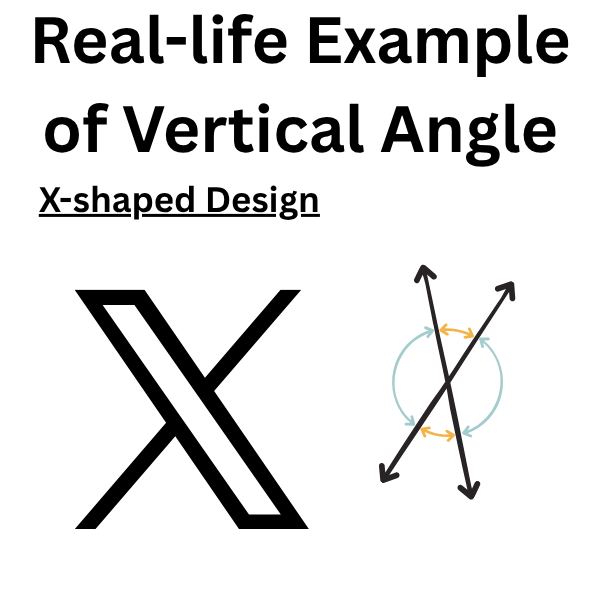
- X-shaped signs
A sign that appears clearly in the shape of an “X” is the most common example of vertical angles.
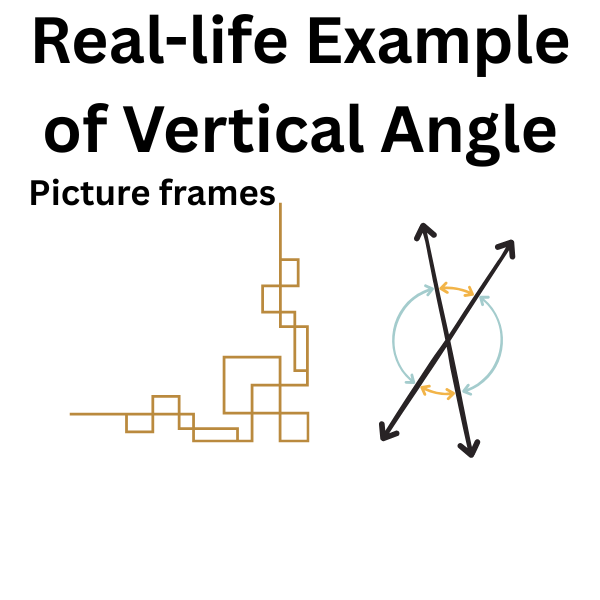
- Picture frames and corners
When the corners of picture frames meet, they can create vertical angles.
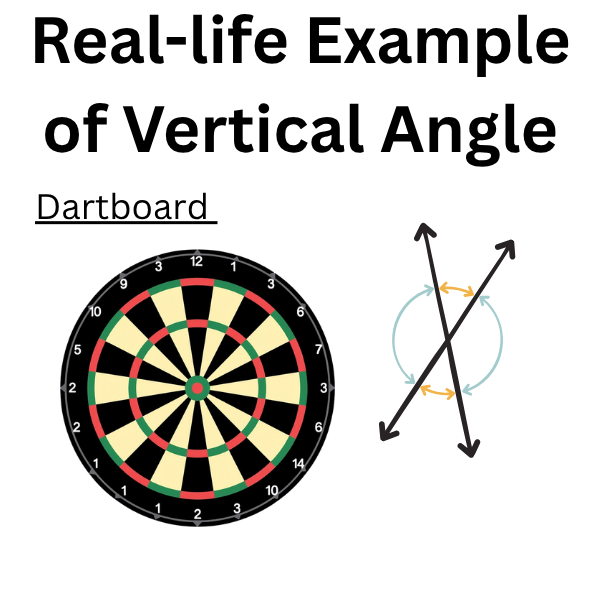
- Dartboard
The center of the dartboard can act as a vertex. Intersecting lines in the board’s design can create multiple pairs of vertical angles around the bull’s eye.
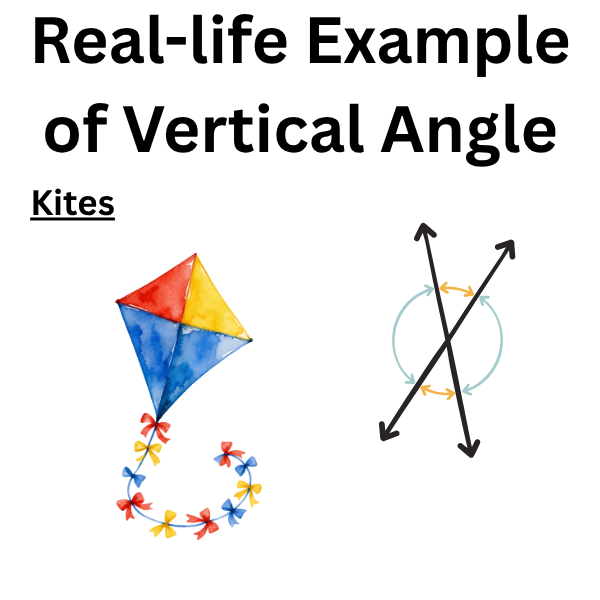
- Kites
In kite designs, the wooden sticks that cross at the center form a pair of vertical angles. This angle helps distribute wind pressure.
Related Topics:
Here are some related articles you can read for a better understanding.
- Real-life examples of right angles
- Real-life examples of acute angles
- Real-life examples of obtuse angles
- Real-life examples of supplementary angles
- Real-life examples of straight angles
Common Mistakes
- Vertical means up-and-down
Vertical is related to vertex, not in the up-and-down direction. They can be in any orientation.
- All opposite angles are vertical.
Vertical angles are formed when straight lines cross each other. Not every opposite angle is a vertical angle.
- Vertical angles always add to 180°
Vertical angles are equal, not necessarily supplementary.
FAQs About Vertical Angles
Q1. Are vertical angles always equal?
Yes. By the Vertical Angles Theorem, vertical angles are always congruent.
Q2. Can vertical angles be right angles?
Yes—if the intersecting lines are perpendicular, all four angles are 90°, and each vertical pair is a pair of right angles.
Q3. Do vertical angles add up to 180°?
They are equal but not necessarily supplementary. It is only in the case when each angle is 90 degree.
Q4. Where can I see vertical angles at home?
Look at: open scissors, an “X” decoration, the pivot on pliers, or the frame of a kite.
Conclusion
In Simple words, when two straight lines intersect, the opposite equal angles are vertical. They can be seen everywhere in daily life, including kites, dartboards, scissors, photo frames, and many others.
When you start noticing that, “What are some real-life examples of vertical angles?” then there will be many examples around you. And these vertical angles are helpful in different tools and systems.

I’m a graduate in mathematics. And I’m here to help students with mathematics on different topics.