
Have you ever noticed objects or diagrams that have angles but do not share a vertex and a common side? These angles are non-adjacent angles. Now we will learn about the real-life examples of non-adjacent angles with images.
First, we will learn the definition of non-adjacent angles.
What are non-adjacent angles?
Two angles that do not share a common side or a common vertex are called non-adjacent angles.
10 Real-Life Examples of Non-Adjacent Angles
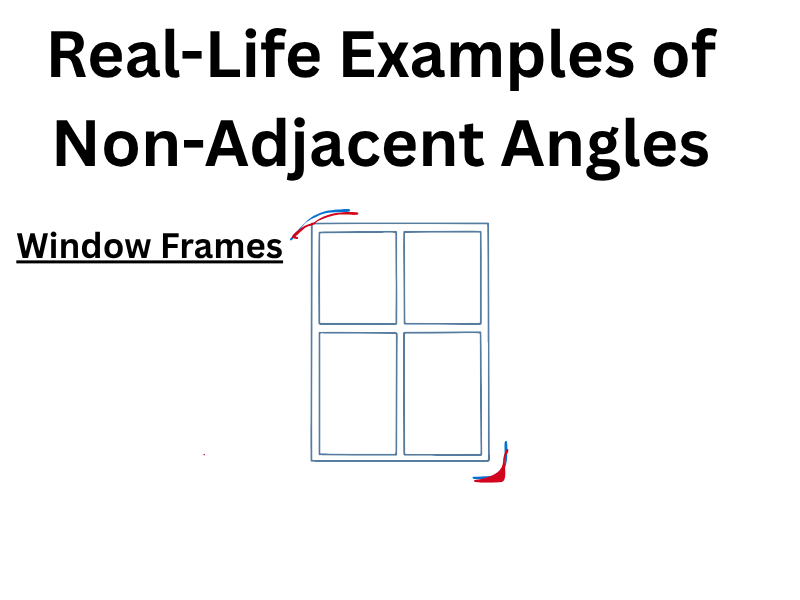
1. Window frames
Looking at a window frame, the two angles at the upper-left and bottom-right corners are non-adjacent because they have no common side or vertex.
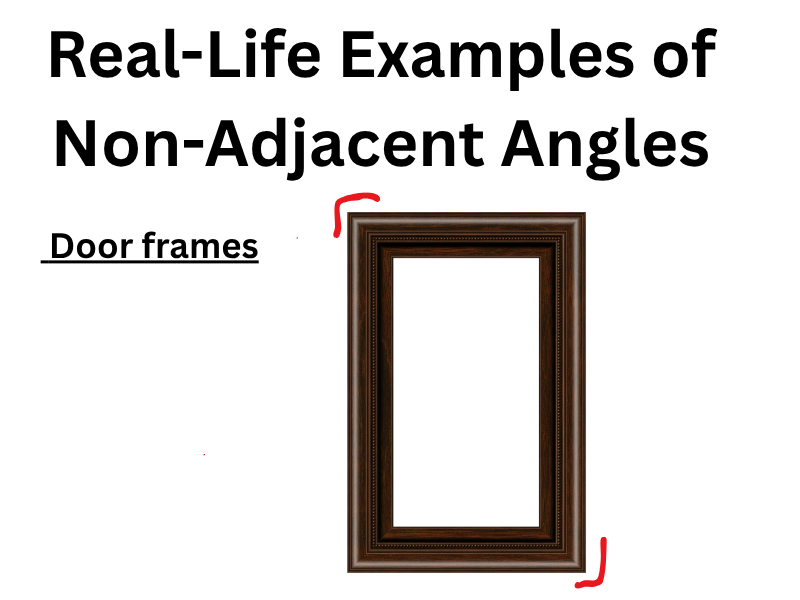
2. Door frames
Doors are rectangular. Any two opposite corners of a door that have no common side and no common vertex form non-adjacent angles.
3. Book covers
Open a book or notebook and look at its cover. The opposite corners of a book cover are non-adjacent because they do not share a common vertex or common side.

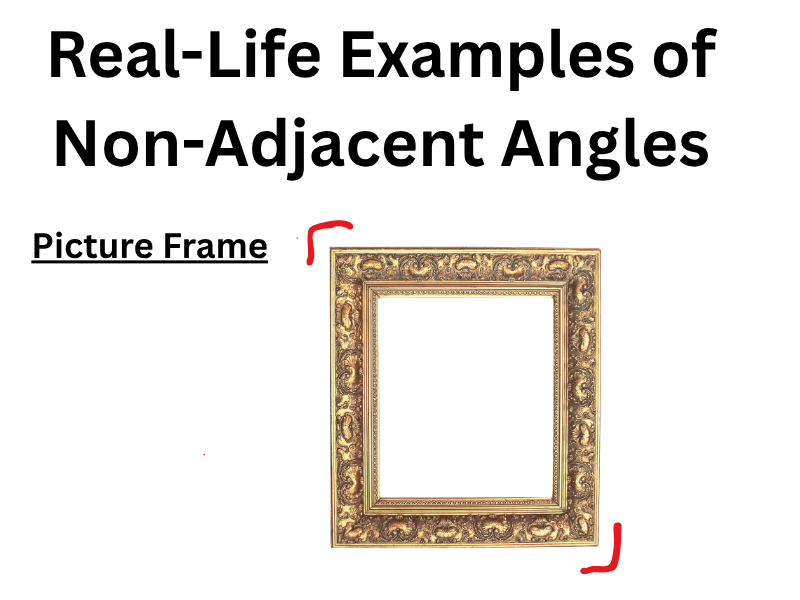
4. Picture frames
The frame has 4 edges. The two opposite corners fulfil the criteria of non-adjacent angles.
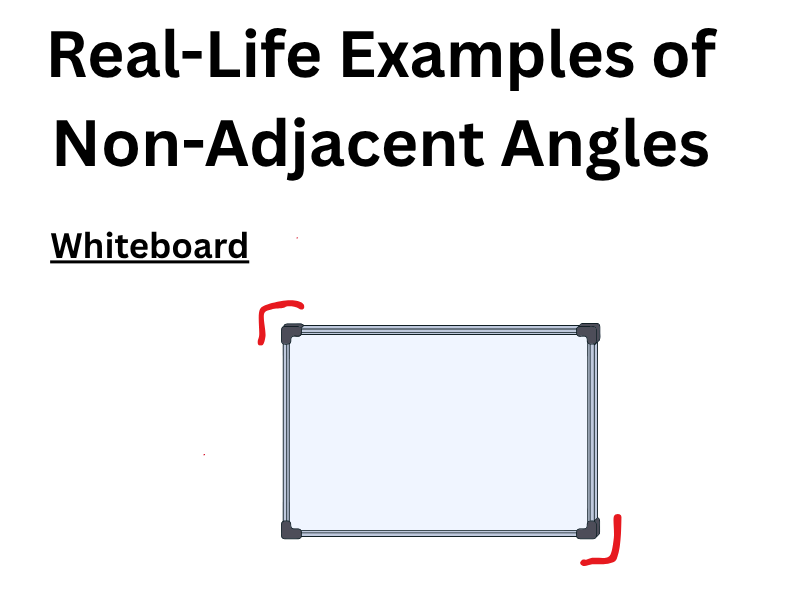
5. Whiteboard
Take a look at the whiteboard in your classroom. Did you ever notice that this whiteboard contains non-adjacent angles? Yes, the opposite corner angles of a whiteboard are non-adjacent.
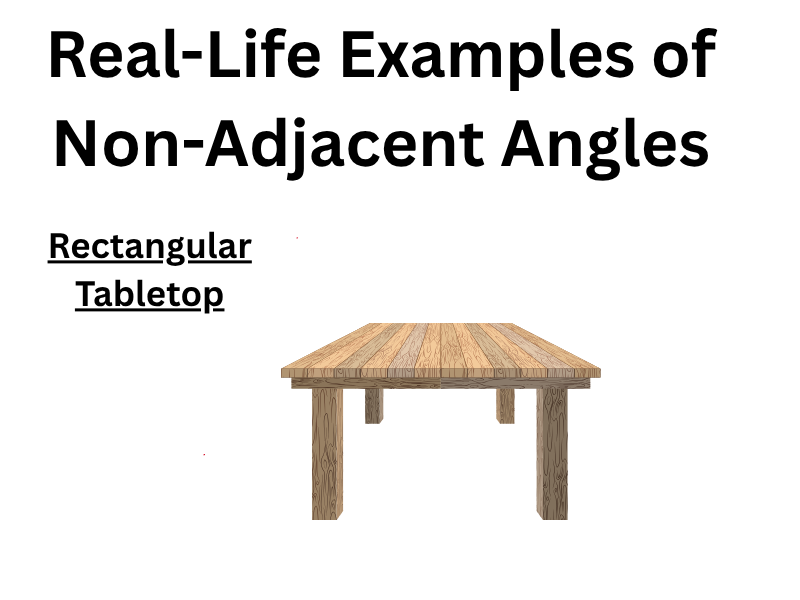
6. Rectangular Tabletop
The surface of a table has four corners, and any two are located opposite each other. Since the two angles do not share a side or common vertex, they are non-adjacent angles.
7. TV Screen
A TV screen has four corner angles. Each corner angle has a non-adjacent angle at the opposite corner because they do not share a common side or a common vertex.

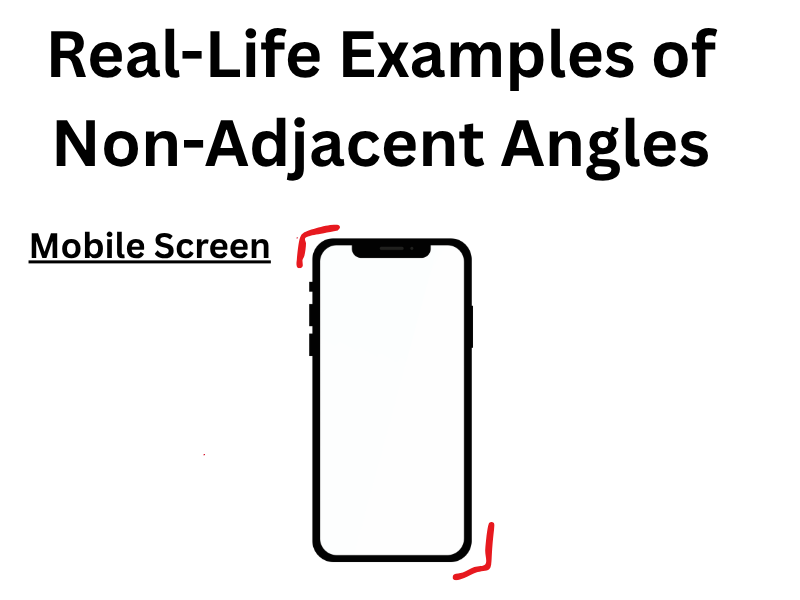
8. Mobile Screens
Hold your mobile phone and observe its screen. The upper-left corner of a mobile screen has its non-adjacent angle at the bottom-right corner, and the upper-right corner has its non-adjacent angle at the bottom-left corner, because these fulfill the definition of non-adjacent angles.
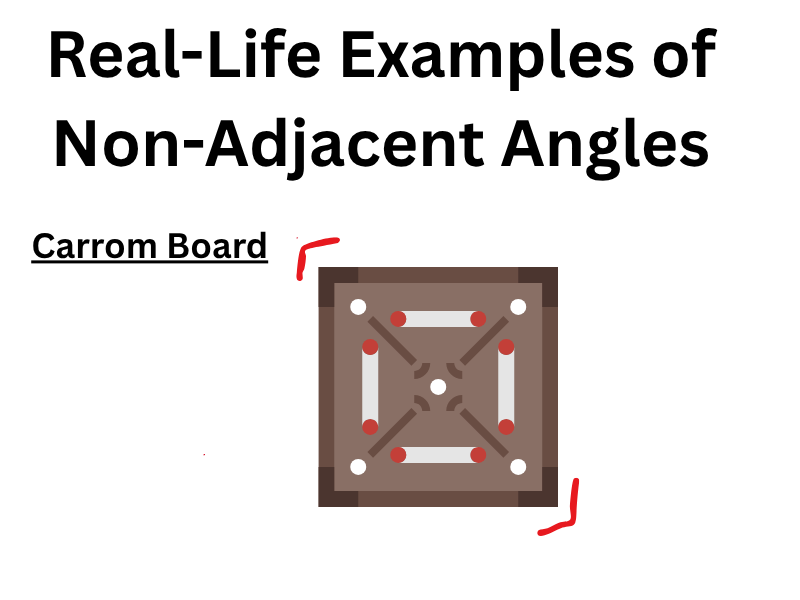
9. Carrom Board
If you enjoy playing carrom, you have probably noticed that the board has four corners. The two angles are non-adjacent because they do not share a common side or vertex.
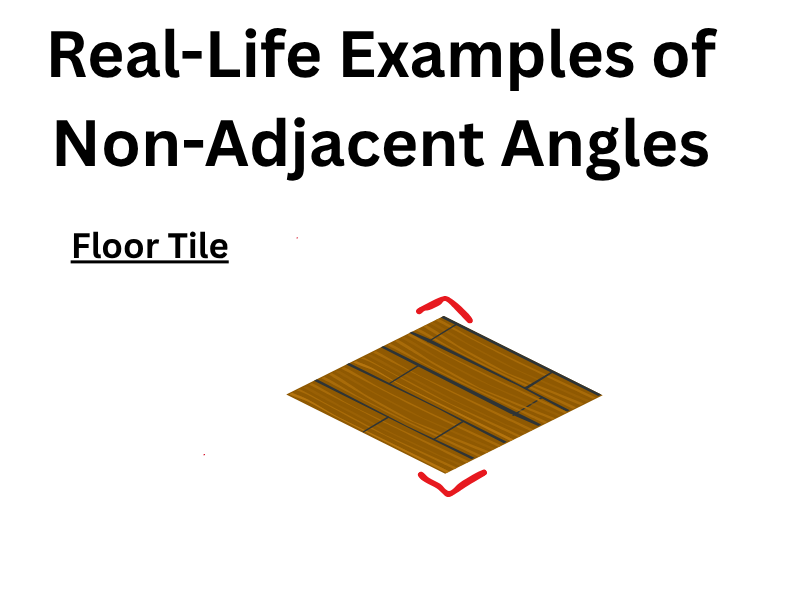
10. Floor Tiles
The tiles we used on our floor are mostly rectangular in shape. Any two corner angles that do not share a common side and do not meet each other form the non-adjacent angles.
Difference Between Adjacent and Non-Adjacent Angles
| Adjacent Angles | Non-Adjacent Angles |
| Share a common vertex | Do not share a common vertex |
| Share one common side | Do not share a common side |
| Touch each other | Do not touch each other |
| Found side by side | Found separately |
| Easy to identify in a single corner | Usually found at different corners |
Importance of Non-Adjacent Angles in Real-Life
Non-adjacent angles are not only a topic of geometry. They have many wide applications in daily life.
Some important applications of non-adjacent angles are
1. Architecture
They are helpful in the design of different structures. Engineers use non-adjacent angles for better structures.
2. Navigation
Many navigators use these angles to navigate locations in different areas.
3. Astronomy
Astronomers and surveyors use geometric angles to measure distances and determine the positions of celestial objects.
4. Engineering
Engineers design machines that have non-adjacent angles, like gears, engines, and many others.
5. Daily life use
Things we use in daily life, like screens, tables, frames, etc., contain non-adjacent angles.
Related Topics:
Here are some related articles you can read for a better understanding.
- Real-life examples of right angles
- Real-life examples of acute angles
- Real-life examples of obtuse angles
- Real-life examples of supplementary angles
- Real-life examples of straight angles
You can also visit Angles on Wikipedia.
FAQs
1. What are the non-adjacent angles?
Two angles that do not share a common vertex or a common side are called non-adjacent angles.
2. What is a common real-life example of non-adjacent angles?
A common real-life example is window frames.
3. Are non-adjacent angles equal?
Non-adjacent angles are not necessarily equal, but in a rectangle and a square, the opposite corner angles are equal. Therefore, the non-adjacent angles are equal.
4. Are vertically opposite angles non-adjacent?
By definition, adjacent angles must share both a common vertex and a common side. Vertically opposite angles share only the vertex, not a side, so they are non-adjacent.
5. What are the real-life examples of non-adjacent angles?
The real-life examples are window frames, book covers, tables, screens, etc.
Conclusion
In this article, we have discussed the real-life examples of non-adjacent angles, which are frames, books or notebook covers, mobile or TV screens, or carrom boards, etc. These examples help relate the geometrical shapes to real-life things.
`

I’m a graduate in mathematics. And I’m here to help students with mathematics on different topics.