
Do you want to know about the real-life examples of adjacent angles? Then you’re in the right place. Here are 10 examples of adjacent angles in daily life.
First, we will learn about adjacent angles
What are adjacent angles?
Adjacent angles are a pair of angles that share a common vertex and side and don’t overlap.
Real-life examples of adjacent angles
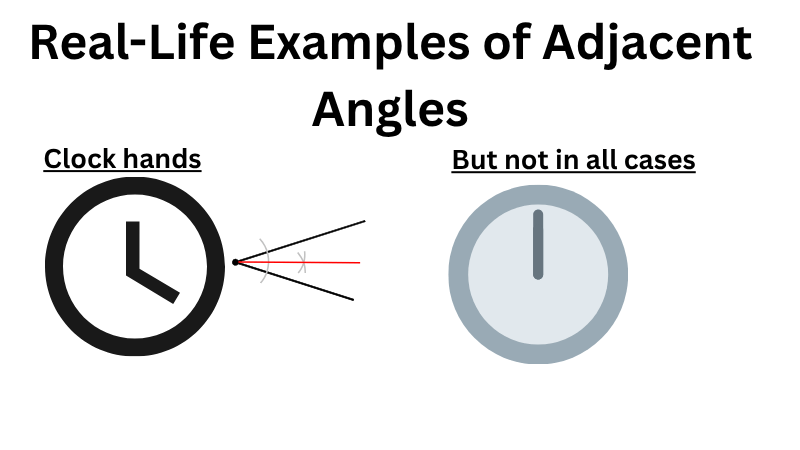
1. Clock hands
In a clock, any two neighboring hands (hour, minute, and second hands) form adjacent angles because they share the common vertex. But not in all cases are they adjacent, as shown in the figure.
2. Bicycle wheels
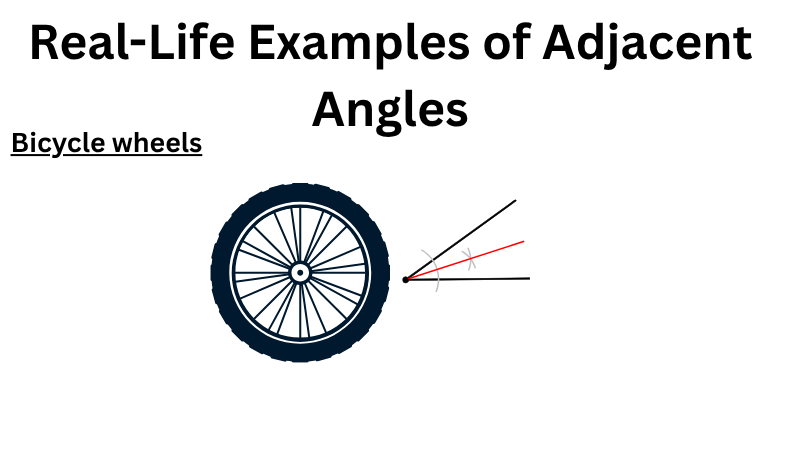
In the bicycle wheel, any two neighbouring spokes form adjacent angles because the center point of the wheel is their vertex, which is the same for all spokes.
3. Windmill blades
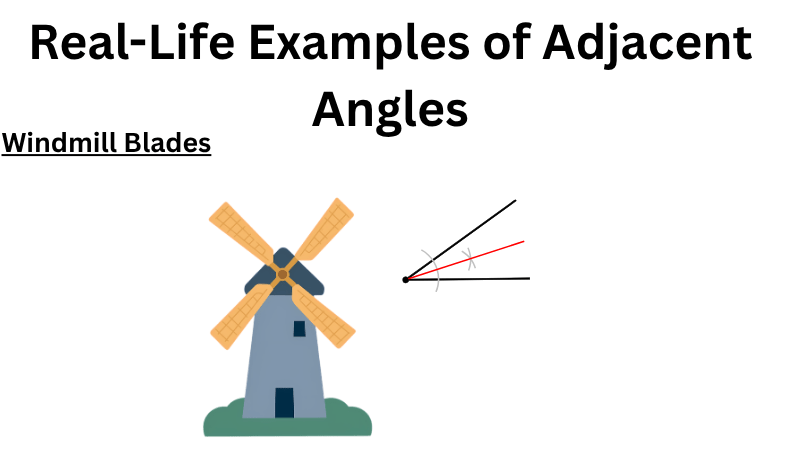
As you know, the windmill turbines rotate to generate electricity. Many blades share the same vertex. Any two turbine blades form adjacent angles.
4. Umbrella ribs
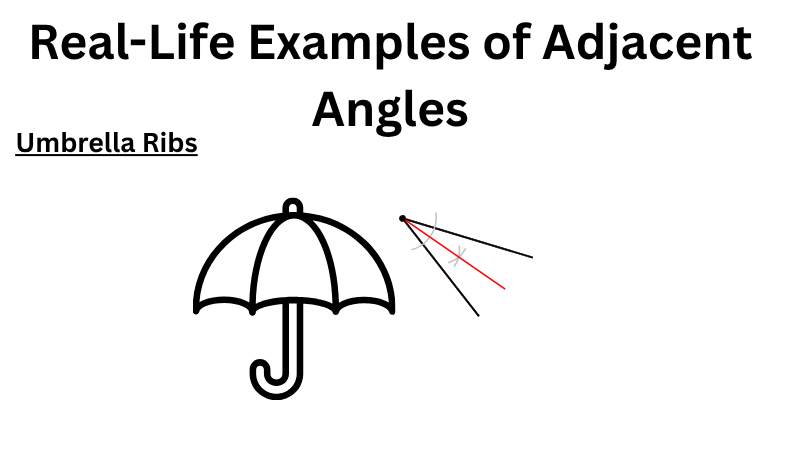
There are many ribs in the umbrella’s design, and they share a common vertex. Any two adjacent ribs form an adjacent angle because they share a common vertex and a common side. This is a common real-life example of adjacent angles.
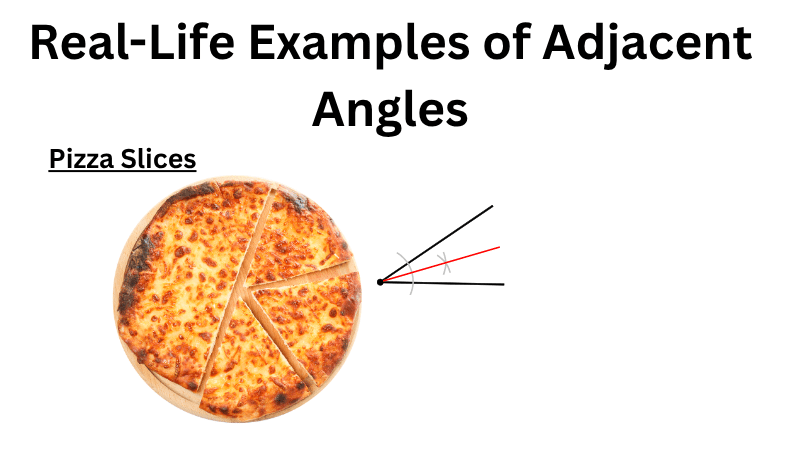
5. Pizza slices
A pizza is divided into many slices, and they meet at a center point. Any two neighboring slices form adjacent angles.
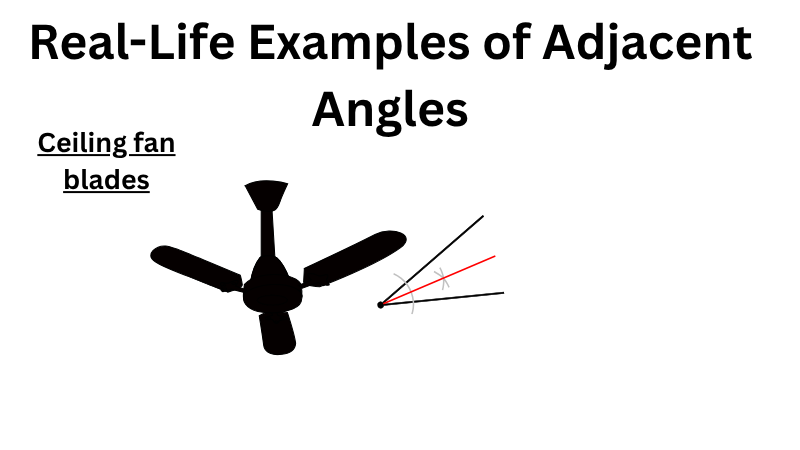
6. Ceiling fan blades
Ceiling fans are also a common example of adjacent angles. The two neighbouring blades form an adjacent angle because they share the common vertex and don’t overlap.
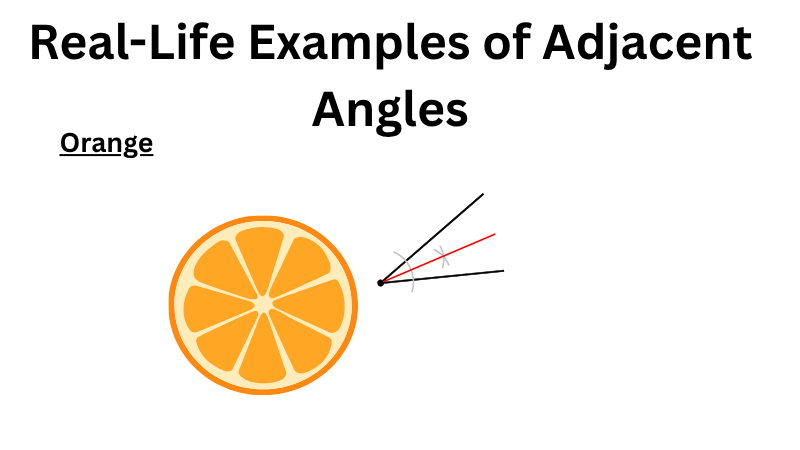
7. Orange
When an orange is cut into several segments, all the segments meet at the center. Any two neighboring segments form adjacent angles.
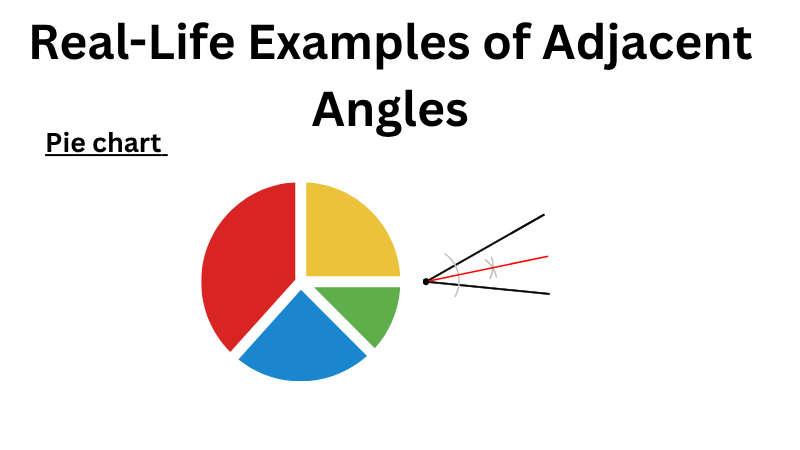
8. Pie Chart
In geometry, there is a type of chart called the pie chart. In a pie chart, there are many sectors, and any two neighbouring sectors form adjacent angles.
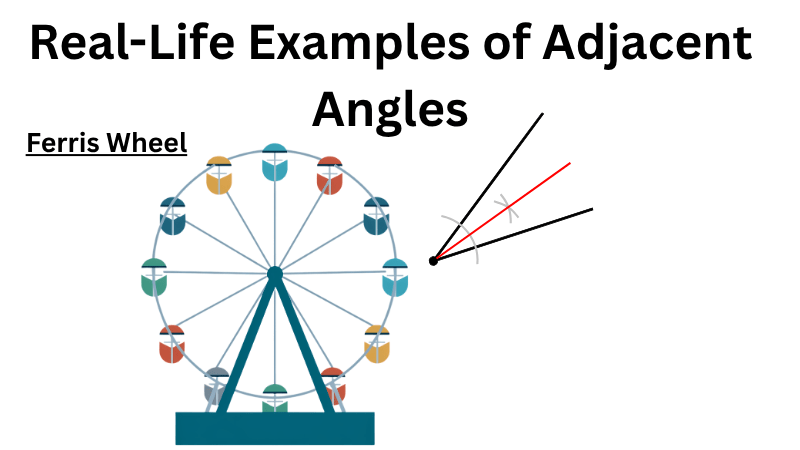
9. Ferris wheel spokes
The spokes have the same main point, and this point works as a vertex, and any two neighboring spokes form adjacent angles.
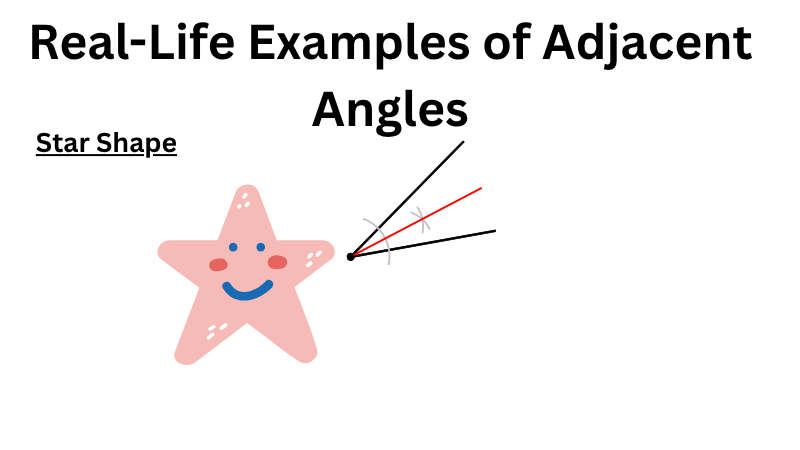
10. Star-shaped things
Many decorative items, stickers, and ornaments have a star shape. The angles formed by neighboring lines at a vertex are adjacent because they share a common side and vertex.
Why Are Adjacent Angles Important?
Adjacent angles are important in daily life. Many things used in daily life have adjacent angles.
- They are used in architecture and the design of different structures.
- They are used in geometry.
- They also appear in wheels, clocks, fans, and many other daily objects.
- They are useful in engineering.
How to Identify Adjacent Angles
Two angles are adjacent if
They share a common vertex.
They share a common side.
They don’t overlap.
Related Topics:
Here are some related articles you can read for a better understanding.
- Real-life examples of right angles
- Real-life examples of acute angles
- Real-life examples of obtuse angles
- Real-life examples of supplementary angles
- Real-life examples of straight angles
You can also visit Adjacent Angles on Wikipedia.
Difference Between Adjacent Angles and Vertical Angles
| Adjacent Angles | Vertical Angles |
| Share a common side | Do not share a common side |
| Share a common vertex. | Share a common vertex. |
| Are next to each other | Are opposite each other |
| May or may not be equal | Are always equal |
FAQs
1. What are adjacent angles?
Adjacent angles are two angles that share a common vertex and a common side without overlapping. They are located next to each other.
2. What are some real-life examples of adjacent angles?
Common real-life examples are wheels, clocks, pizza slices, orange segments, and many others.
3. Are adjacent angles always equal?
No. Adjacent angles are not always equal.
4. Can adjacent angles form a linear pair?
Yes, when their measures add up to 180°, they form a linear pair.
5. How can you identify adjacent angles?
To identify adjacent angles, check whether they share a common vertex and a common side and do not overlap.
Conclusion
Common real-life examples of adjacent angles include clock hands, bicycle wheel spokes, windmill blades, umbrella ribs, pizza slices, ceiling fan blades, orange segments, pie charts, Ferris wheel spokes, and star-shaped objects. After reviewing this article, every beginner can easily find the adjacent angle around themselves.

I’m a graduate in mathematics. And I’m here to help students with mathematics on different topics.
Woah! I’m really digging the template/theme of this site.
It’s simple, yet effective. A lot of times it’s difficult to get that “perfect balance” between user friendliness
and appearance. I must say that you’ve done a very good job with this.
In addition, the blog loads extremely fast
for me on Safari. Outstanding Blog!