
Straight angles are one of the most common types of angles found in everyday life. You see many straight or flat things daily in your life. But have you ever noticed that these things can form an angle? Yes, those things form a straight angle. Before exploring the real-life examples of straight angles, we should start with their definition.
What is a straight angle?
A straight angle is an angle that measures exactly 180 degrees and forms a straight line.
Related Topics:
Here are some related articles you can read for a better understanding.
- Real-life examples of right angles
- Real-life examples of acute angles
- Real-life examples of obtuse angles
- Real-life examples of supplementary angles
- You can also check straight angles on Wikipedia for a better understanding.
Real-life Examples of Straight Angles
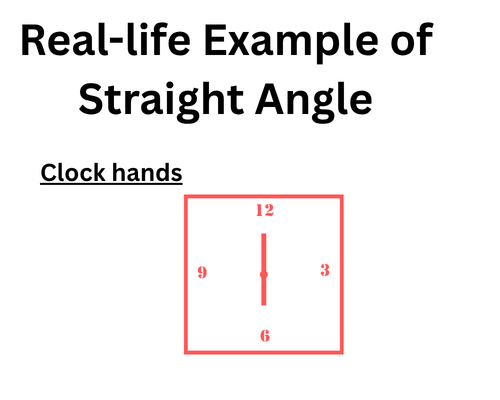
1. Clock hands
At 6 o’clock or 12:30, the hands of the clock align in a straight line. This means that the minute hand and the hour hand form a straight angle. So, a clock is a common example of a straight angle.
2. Railway Track
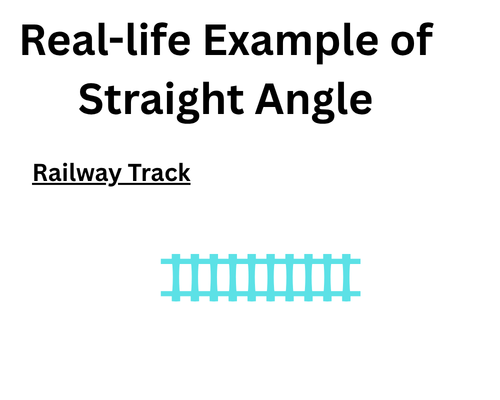
A long, straight railway track appears as a single line. It is a practical example that helps visualize a straight angle.
3. Seesaw
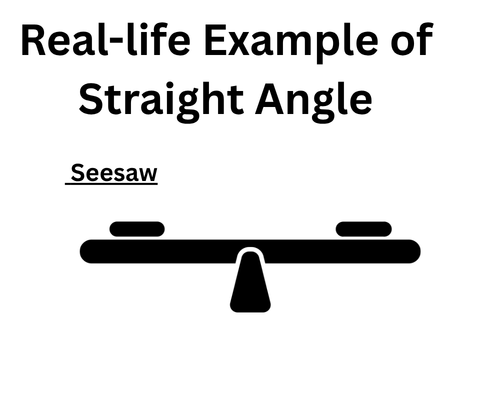
In the park, when the seesaw is in balance, it forms a straight angle between its two sides. When there is the same weight on both sides, it becomes an example of a straight angle.
4. Construction Beam
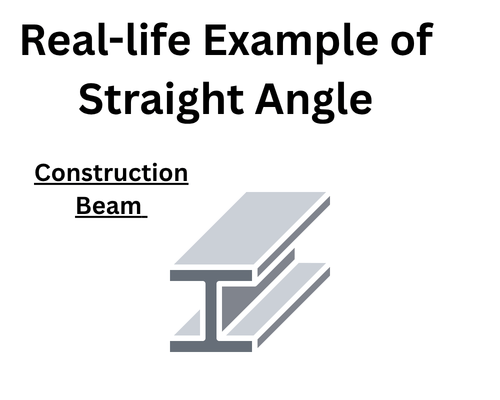
The long steel beam is an example of a straight angle on construction sites. It forms a straight path.
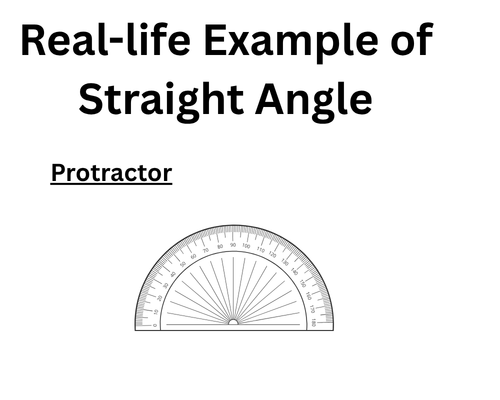
5. Protractor
The most common example of a straight angle in a geometry instrument is a protractor. It is the basic visual example of a straight angle.
6. Roads
A long road without any curves is often visually a straight line because it forms a straight path.
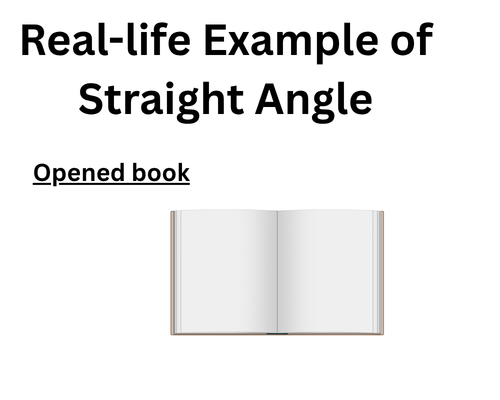
7. Opened the book
When you open the book in half, it becomes flat. The angle between the two surfaces of the book forms a straight angle.
8. Folded Paper Opened Flat
When a folded sheet of paper is opened completely and laid flat, the angle between its two halves becomes a straight angle.
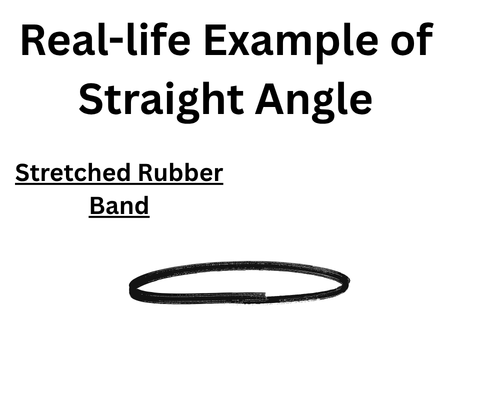
9. Stretched Rubber Band
When you stretch the rubber band from both sides, there is no curve in it. The angle between the two edges is straight.
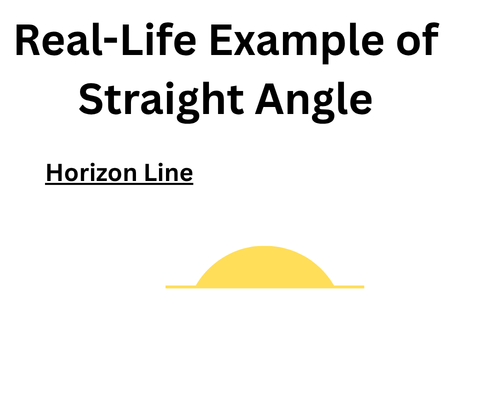
10. Horizon Line
When you look at the horizon, where the sky appears to meet the land or sea, it looks like a perfectly straight line. This straight line is often used to visualize a straight angle.
Why are straight angles important in daily life
Straight angles are not only a topic of geometry, but they also have many applications in daily life.
1. Architecture
It helps in designing different buildings and structures with straight sides.
2. Engineering
Many machines have straight angles in them.
3. Entertainment
In fun lands and amusement parks, there are many things that have straight angles in their structure. In short, you can see straight angles everywhere in your daily life.
4. Transportation
The railway tracks, roads, or runways visually show straight angles.
5. Mathematics
Students use straight angles to understand angle relationships in the academic syllabus.
How to analyze straight angles
The first thing is that many things show a straight structure, almost at a straight angle. You can easily observe them by keeping in mind the definition of straight angles. You can also measure them by using a protractor; if it is exactly 180, then it is a straight angle.
FAQs:
Q1. What is a straight angle?
An angle that measures exactly 180 degrees is called a straight angle.
Q2. What are the real-life examples of straight angles?
The real-life examples of straight angles are a seesaw, railway tracks, open books, and a protractor.
Q3. Why are straight angles important for students?
Students can learn about the relationships among angles, solve geometry problems, and relate angles to daily life.
Q4. What is another name for straight angles?
Another name for straight angles is a flat angle.
Q5. How many degrees are there in a straight angle?
There are exactly 180 degrees in a straight angle.
Conclusion:
Real-life examples of straight angles include a seesaw, a protractor, roads, an open book, beams, and many others. These examples show how 180 degrees appear in real life. In fact, straight angles are everywhere in daily life. They have many applications in daily life, whether it is architecture, entertainment, engineering, or other fields.

I’m a graduate in mathematics. And I’m here to help students with mathematics on different topics.