
The method of combining the unique elements of two or more sets into a single set is called the union of sets. It is represented by the symbol ‘∪’, and the word “or” is used in its mathematical definition. Repeated elements are written only once.
In this article, we will look at the definition of a union, examples involving two and three sets, and detailed solutions.
What Is the Union of Sets?
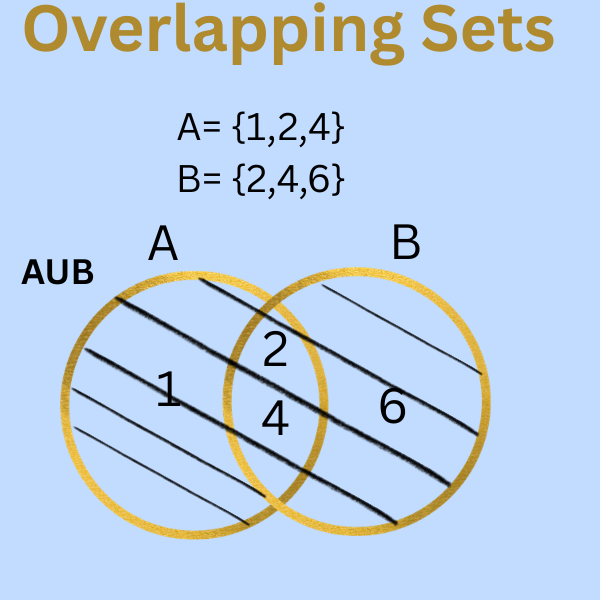
The union of two sets A and B forms a set consisting of the elements of set A and set B, and the repeated elements are written only once.
It is represented as A ∪ B.
In mathematical notation,
A ∪ B = {x | x ∈ A or x ∈ B}
Here, the word “or” means that elements belong to A or B.
For Example,
Let:
A={2,4,6}
and
B={0,4,6,8,10}
According to the definition of the union of sets, here is a set that has the elements of both set A and set B.
A∪B={0,2,4,6,8,10}
Do you take a look at 4 and 6? These are written only once because they are in both sets.
How to Find the Union of Two Sets
Here are some simple steps that will help in finding the union of any two sets. After these steps, you will get solved examples of the union of different sets for better understanding.
1. Write the elements of the first set.
2. Also write the elements of the second set.
3. Don’t write the elements of the second set that are already in the first set.
4. Arrange the elements in a suitable order, usually from smallest to largest.
Examples of Union of Sets with Answers
Example 1:
These sets have common elements, and their union will write the common elements only once.
Let
A={1,3,5,7}
B={1,2,6,8}
Then,
A∪B={1,2,3,5,6,7,8}
Example 2:
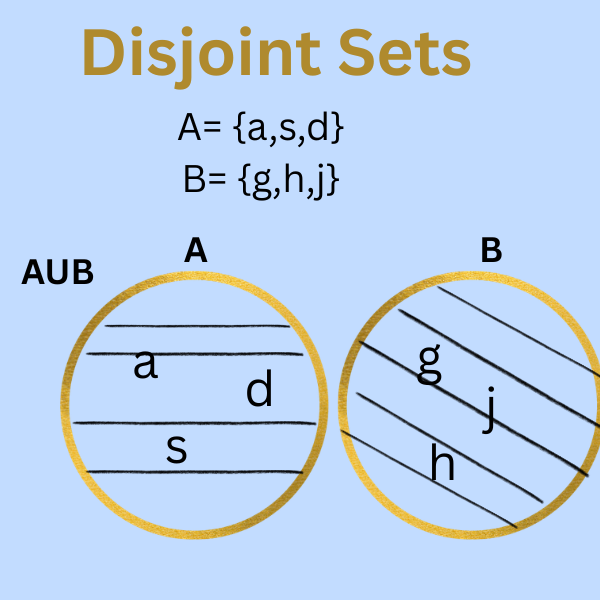
Here are the sets that have disjoint elements. There is no common element in both sets, so the union will contain the elements of both sets.
Let:
P={10,20,30}
Q={50,60,70}
Then,
P∪Q={10,20,30,50,60,70}
Example 3:
Here, set M is a subset of set N, and the union of these sets will contain all the elements of the superset, i.e set N.
Let:
M={a,b,c}
N={a,b,c,d,e,f}
Then,
M∪N= {a,b,c,d,e,f}
You will note that if M⊆N, then M∪N=N.
Example 4:
Both sets have letters.
Let:
U={a,e,i,o,u}
V={a,b,d,e}
Then,
U∪V= {a,b,d,e, i,o,u}
Example 5:
Both sets have names.
Suppose:
A={Ali, Ahmad, Anis}
B={Ben, David, Elena}
Now,
A∪B={Ali, Ahmad, Anis, Ben, David, Elena}
Example 6:
Union of three sets with disjoint elements.
Let:
A={1,2,3}
B={4,5,6}
C={7,8,9}
First, take the union of two sets
A∪B={1,2,3,4,5,6}
Now,
(A∪B)∪C={1,2,3,4,5,6,7,8,9}
Example 7:
Sets of Multiples
Let:
X={2,4,6,8}
Y={3,6,9,12}
Z={4,8,12,16}
Then:
X∪Y∪Z={2,3,4,6,8,9,12,16}
Example 8:
Union with an empty set
Let:
A={4,6,10,14}
Then:
A∪∅={4,6,10,14}
Example 9:
Union of Odd and even numbers
Let:
E={2,4,6,8}
and
O={1,3,5,7,9}
Then:
E∪O={1,2,3,4,5,6,7,8,9}
Example 10:
Let:
A={x∈N∣1≤x≤4}
and:
B={x∈N∣4≤x≤7}
Writing the sets in simple form:
A={1,2,3,4}
B={4,5,6,7}
Therefore:
A∪B={1,2,3,4,5,6,7}
Practice Questions
Q1. If A={1,2,3} and B={2,3,4}, then find A∪B.
Q2. Find: P∪Q where:P={a,c,e},Q={b,d,f}.
Q3. Find: X∪Y where: X={10,20,30,40},Y={20,40}.
Q4. If: A={1,3,6},B=∅ find A∪B.
Q5. Let: A={12,14,16},B={1,13,15},C={6,17,18} Find A∪B∪C.
Properties of Union
Here are some common and important properties of the union of sets that will help in solving questions based on union.
1. Commutative Property
A∪B=B∪A
2. Associative Property
(A∪B)∪C=A∪(B∪C)
3. Identity Property
A∪∅=A
4. Idempotent Property
A∪A=A
FAQs
Q1. What is the union of two sets?
The union of two sets contains every unique element of both sets and doesn’t repeat the same element. It is represented by:
A∪B
Q2. Can an element appear twice in a union?
No. An element appears only once in a union.
Q3. What is the union of a set and the empty set?
When we take the union of any set, like set A, with the empty set, we get the same original set as a result.
A∪∅=A
Q4. Is union the same as addition?
No. Union is not the same as ordinary addition.
Q5. Which symbol represents union and which represents intersection?
The symbol “∪” represents union, while “∩” represents intersection.
Conclusion
In this article, we have solved examples of the union of sets with answers for students’ practice. The union of different types of sets is solved one by one. After this article, any student can easily take the union of sets.

I’m a graduate in mathematics. And I’m here to help students with mathematics on different topics.