
If you’re looking for the difference between an isosceles triangle and an equilateral triangle, then you’re in the right place. Then you’re in the right article. In this section, we will discuss all things about these triangles. After reading this article, you will be able to differentiate between isosceles and equilateral triangles, and you can relate them to real life.
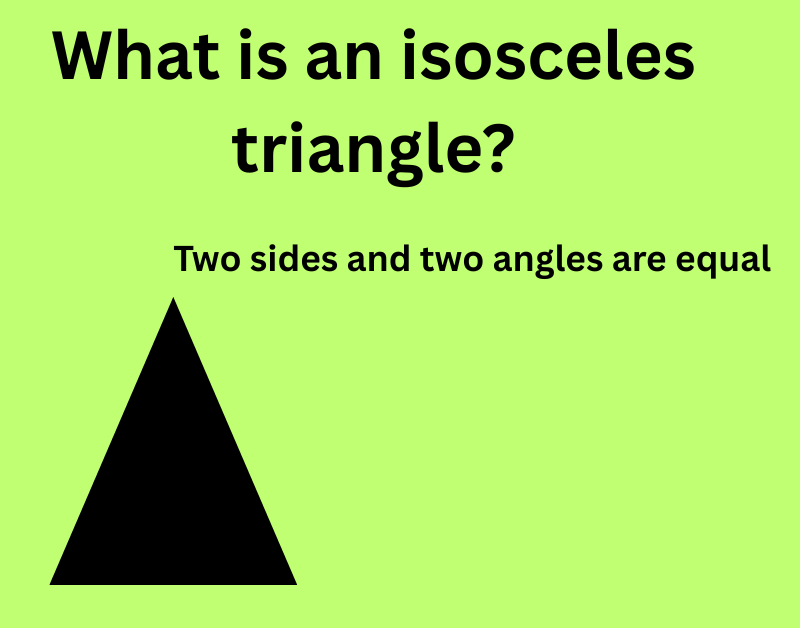
What is an isosceles triangle?
An isosceles triangle is a triangle with two equal sides and two equal angles. The third side may have a different length.
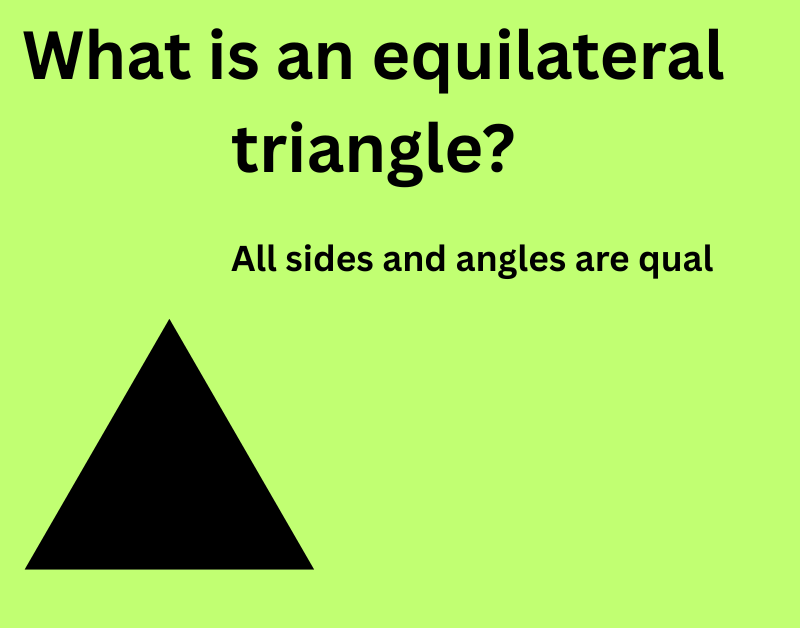
What is an equilateral triangle?
A triangle in which all three sides are equal is called an equilateral triangle. All the angles are 60 degrees.
Difference between an Isosceles triangle and an Equilateral triangle
In this section, you will learn about the difference between an isosceles triangle and an equilateral triangle with examples. You can easily differentiate them by visualizing them.
| Feature | Isosceles Triangle | Equilateral Triangle |
| Definition | A triangle with two equal sides. | A triangle with three equal sides. |
| Number of Equal Sides | 2 | 3 |
| Number of Equal Angles | 2 | 3 |
| Angle Measure | Two angles are equal, but their measures can vary. | All three angles are 60°. |
| Third Side | May be different from the other two sides. | All sides are equal, so there is no different side. |
| Symmetry | Has 1 line of symmetry. | Has 3 lines of symmetry. |
| Rotation Symmetry | Order 1 | Order 3 |
| Regular Polygon | No | Yes |
| Perimeter Formula | Sum of all three sides (a + a + b). | 3 × side (3a). |
| Area Formula | Depends on the base and height: ½ × base × height. | (√3/4) × side². |
| Example | Triangle with sides 5 cm, 5 cm, 8 cm. | Triangle with sides 6 cm, 6 cm, 6 cm. |
Properties of an Isosceles and an Equilateral Triangle
Here are some properties of an isosceles triangle and an equilateral triangle. We will see them one by one.
Properties of an Isosceles Triangle
Sides: Any two sides are equal, and one side is unequal
Base: The unequal side is called the base of an isosceles triangle.
Base Angle: The two angles that are opposite the equal sides are equal and called the base angles.
Vertex Angle: Any angle that is between the two equal sides is called the vertex angle.
Properties of an Equilateral Triangle
Sides: All three sides are equal in length.
Base: There is no specific base in an equilateral triangle. You can take any side as a base.
Base Angles: All the angles are equal. So it does not matter which angle is the base and which is the vertex angle.
Real-Life Examples of Isosceles and Equilateral Triangles
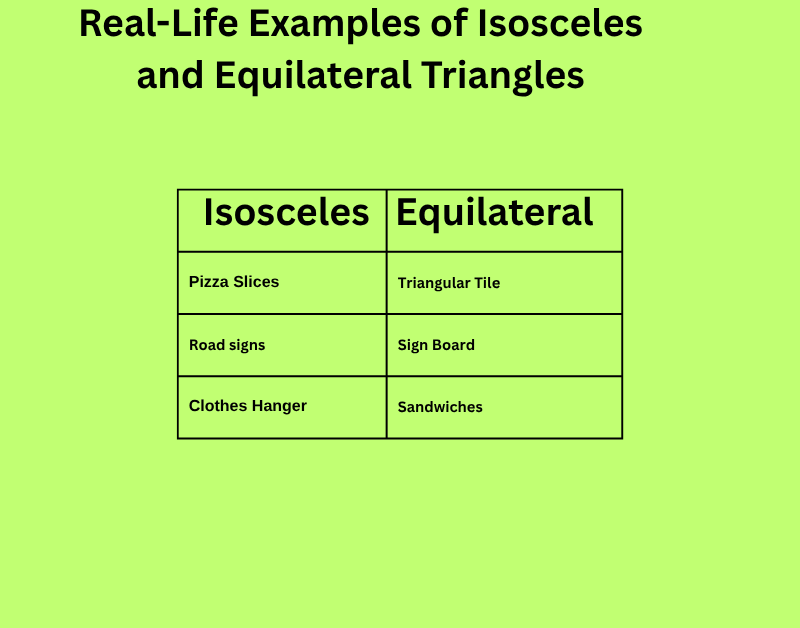
Real-Life Examples of an Isosceles Triangle
- Pizza Slices
A pizza slice cut from the center of a circular pizza forms an isosceles triangle because it has two equal sides and one unequal side.
- Road signs
While travelling on the road, two equal sides form an isosceles triangle.
- Clothes Hanger
The hanger has two sides that are equal, and one side is unequal, which is the base. So this is a real-life example of an isosceles triangle.
Real-Life Examples of an Equilateral Triangle
- Triangular Tile
We use different decorative tiles in construction. Some floor and wall tiles are made in an equilateral shape.
- Sign Board
The signboards used on the roads are in the shape of an equilateral triangle.
- Sandwiches
Some sandwiches are cut into equal triangular pieces, making them resemble an equilateral triangle.
You can also explore angles, isosceles triangles, and equilateral triangles for further reading.
Can an equilateral triangle be isosceles?
According to the definition of an isosceles triangle, it must have at least two sides that are equal. As we know, in an equilateral triangle, there are three sides equal in length. So it fulfills the criteria of an isosceles triangle. Hence, we can say that the equilateral triangle is isosceles, but not all isosceles triangles are equilateral triangles.
FAQs
1. What is the difference between an isosceles triangle and an equilateral triangle?
An isosceles triangle has at least two sides equal, and an equilateral triangle has 3 equal sides in length.
2. Are all equilateral triangles isosceles?
Yes, all equilateral triangles are isosceles triangles because they have two sides equal in length.
3. Is an isosceles triangle 180 or 360?
The main thing is that the sum of the interior angles is equal to 180 degrees.
4. What is the other name of an equilateral triangle?
Another name is an equiangular triangle because it contains all equal angles that are exactly 60 degrees.
5. Are all isosceles triangles obtuse?
An isosceles triangle could be acute, right, or obtuse.
Conclusion
This section has covered the difference between an isosceles triangle and an equilateral triangle. We have discussed their definitions, differences, real-life examples, and properties. After this article, you will be familiar with isosceles and equilateral triangles, which have three sides but differ in the number of equal sides. You will be able to identify each type of triangle in geometry and in real life easily.

I’m a graduate in mathematics. And I’m here to help students with mathematics on different topics.