
Introduction:
Have you ever wondered why two angles together make a perfect straight line (180°) or a right angle (90°)?
This isn’t just something to memorize — it’s actually used in real life too, like in construction, design, and even mobile graphics.
If you only understand angles through definitions, then you’re only getting half the concept. In this blog, we’ll understand complementary and supplementary angles for Class 6 students properly — in a simple way, without any confusion.
What is an angle?
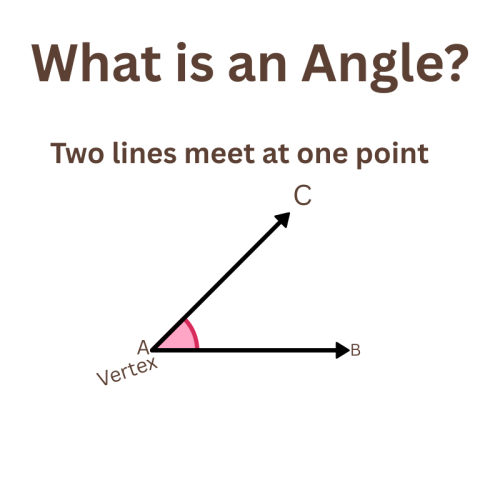
An angle is formed when two lines meet at one point. That point is called the vertex.
You can also check the types of angles in geometry.
Now we will read about complementary and supplementary angles in easy and simple language.
What are Complementary Angles?
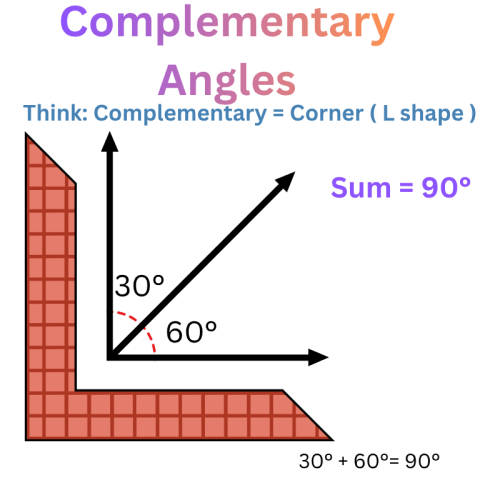
If the sum of two angles is 90°, then they are called complementary angles.
For example:
45° + 45° = 90°
20° + 70° = 90°
Each angle is called the complement of the other.
In the above examples:
45° is the complement of the other.
20° is the complement of 70°, and 70° is the complement of 20°.
What are Supplementary Angles?
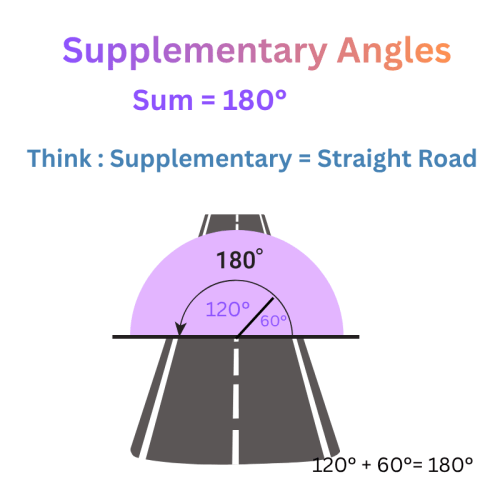
Two angles whose sum is 180° are called supplementary angles.
For example:
120° + 60° = 180°
90° + 90° = 180°
Each angle is called the supplement of the other.
In the above examples:
120° is the supplement of 60°, and 60° is the supplement of 120°.
90° is the supplement of the other.
Complementary vs Supplementary Angles (Clear Difference):
| Feature | Complementary Angles | Supplementary Angles |
| Sum | 90° | 180° |
| Shape | Right angle | Straight line |
| Example | 30° + 60° | 100° + 80° |
| Visual | L-shape | Straight line |
Fast Solving Method:
We will see how to find complementary and supplementary angles for Class 6 in this section.
If you’re given an angle:
To find the complementary:
90° – given angle
To find the supplementary:
180° – given angle
Complementary and Supplementary Angles for Class 6 Examples:
Angle = 45°
Complement = 90° – 45° = 45°
Supplement = 180° – 45° = 135°
Q1. The measure of an angle is 30°. What is the measure of its complementary and supplementary angles?
For the complementary angle:
Here, x is the angle that we want to find
x + 30° = 90°
x = 90° – 30°
x = 60°
For Supplementary angle:
x + 30° = 180°
x = 180° – 30°
x = 150°
Q2. There are two angles, 60° and 40°. Find whether they are complementary or not.
As we know, the sum of complementary angles is equal to 90°. So,
60° + 40° = 100°
It means that these are not complementary angles.
Q3. There are two angles, 60° and 120°. Find whether they are supplementary or not.
As we know, the sum of supplementary angles is equal to 1.0°. So,
60° + 120° = 180°
It means that these are supplementary angles.
Real Life Use:
Architecture: Walls (complementary)
Road design: Straight roads (supplementary angles)
Mobile UI design: Layout alignment
Engineering drawings
Common Mistakes (Avoid):
Confusing 90° and 180°
Considering three angles are complementary (there are only two)
Not drawing a diagram — the biggest mistake
Practice Questions:
If an angle is 25°, what is its complement?
An angle is 110°; what is its supplement?
Try it yourself first, then check;
Answer 1: 65°
Answer 2: 70°
Brain Visualization Trick:
Students often forget what happened, but they never forget what happened with their eyes.
Whenever you encounter questions about complementary and supplementary angles, try to think them through visualization.
Complementary = 90 (corner of a room)
Supplementary = 180 (straight road)
FAQ’s:
Q1. What is the basic difference between complementary and supplementary angles for class 6?
The basic difference is that the sum of complementary angles is 90° and the sum of supplementary angles is 180°.
Q2. How can we remember the difference?
Complementary = corner (90°)
Supplementary = straight (180°)
Q3. Are complementary angles always adjacent?
No, they are not always adjacent. Their sum should be 90°.
Q4. Are supplementary angles always adjacent?
No, they are not always adjacent. Their sum should be 180°.
Q5. How to find complementary and supplementary angles for Class 6? Give examples.
For Complementary angles:
Angle = 5Class° – 50° = 40°
For Supplementary angles:
Angle = 50°
180° – 50° = 130°
Conclusion:
Complementary and supplementary angles for Class 6 aren’t difficult — you need a clear concept.
If you remember the sums (90° and 180°), 80% of problems are solved automatically.
If you want more details on this, you can view complementary and supplementary angles on Wikipedia.
Final tip:
Draw diagrams
Use shortcuts
Relate to real-life problems.

I’m a graduate in mathematics. And I’m here to help students with mathematics on different topics.