
Introduction:
Angles are a basic concept in geometry, but many students get confused about them. The good news is that once you understand the types of angles for Class 6 properly, things like triangles and other shapes become much easier to understand.
In this article, we’ll go through the different types of angles using simple examples and a few practice questions, so you can understand everything clearly and solve problems with confidence.
What is an Angle?
Let’s understand this in a very simple way.
When two lines meet at one point, they form an angle. That meeting point is called the vertex, and the two lines are called the arms of the angle.
Real-life Examples of Angles:
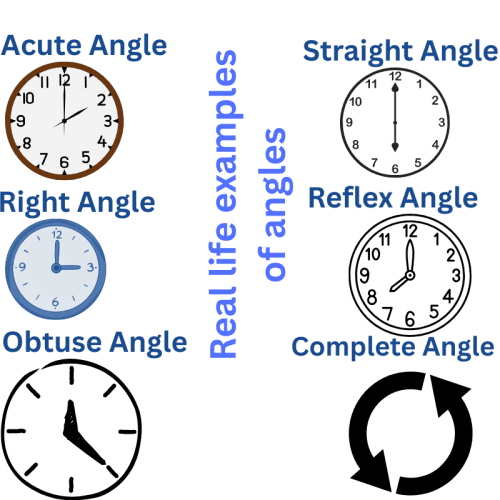
You don’t need to just memorize this. You can actually see angles around you:
- When you open a door, look at the space between the door and the wall — that’s an angle.
- Check a clock — the hands are always making different angles.
- Even the corner of your book or table is an angle.
When you start noticing these things, angles become very easy to understand.
A simple trick to remember
If two lines meet, an angle is made.
If they don’t meet, there is no angle.
Why do angles matter?
Angles are used in many parts of math. For example:
- In triangles
- In different shapes
- In solving math problems
So once you understand angles properly, the rest of geometry starts to feel much easier.
Types of Angles for Class 6:
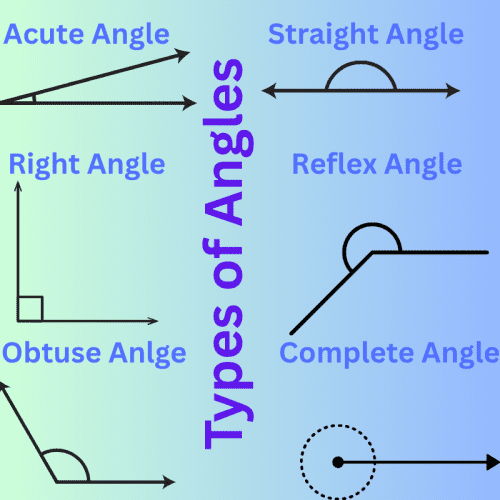
Angles are classified into different types based on their size. The most common basic values are 90°, 180°, and 360°, which are used to identify the types of angles in Class 6.
- Acute Angle
An angle that is less than 90° is called an acute angle. For example 30°, 45°, or 60°.
In real life, if we look at a clock, 1 o’clock or 2 o’clock are examples.
- Right Angle
An angle that is exactly 90°.
All angles in a square and a rectangle are 90°.
- Obtuse Angle
An angle that is more than 90° but less than 180° is known as an obtuse angle. For example, 100°, 120°
- Straight Angle
An angle that is 180°.
A straight line without any bends has a 180° angle.
- Reflex Angle
An angle that is more than 180° but less than 360° is a reflex angle. For example 220°, 260°, etc.
In real life, when you turn more than half but not a full circle, it forms a reflex angle.
- Complete Angle
An angle of 360° is called a complete angle.
In real life, if there is a full rotation in a circular shape, it forms a 360° angle.
Common Mistakes to Avoid
Many students struggle with learning types of angles for Class 6 and make mistakes while identifying them.
Never consider 90° an acute angle.
Never consider 180° an obtuse angle.
It’s always better to understand angles by drawing them.
How to Identify an Angle Easily:
The easiest way is to compare your angle with the basic angles 90°, 180°, and 360°. This helps you quickly understand what type of angle it is.
- If the angle is less than 90°, it is an acute angle
- If the angle is exactly 90°, it is a right angle
- If the angle is more than 90° but less than 180°, it is an obtuse angle
- If the angle is exactly 180°, it is a straight angle
- If the angle is more than 180° but less than 360°, it is a reflex angle
- If the angle is exactly 360°, it is a complete angle
If you keep these simple points in mind, it becomes very easy to identify any angle. Now let’s look at some examples.
Solved Examples:
Here are the types of angles for Class 6 with examples.
Example 1:
Angle = 30°
It is an acute angle.
Example 2:
Angle = 90°
It is a right angle.
Example 3:
Angle = 120°
It is an obtuse angle.
Example 4:
Angle = 180°
It is a straight angle.
Example 5:
Angle = 230°
It is a reflex angle.
Practice Questions:
Here are the angle questions for Class 6 with answers for practice.
Find the types of these angles
- 40°
- 100°
- 150°
- 200°
- 320°
Answers:
40° → Acute
100° → Obtuse
150° → Obtuse
200° → Reflex
320° → Reflex
Conclusion:
In this article, we have tried to understand new types of angles for Class 6 in an easy and simple way. In this, along with the introduction, we have also taught how to identify the types. And for the ease of students, solved examples of types of angles for class 6 with answers and practice questions have been given for practice.
After this article, it will become easy for you to identify types of angles and make diagrams.
If you want to strengthen your angle basics, you can also check the Angles guidance on Wikipedia.
FAQ’s:
What is an angle?
An angle is formed when two lines meet at one point, and this point is called the vertex.
What are the types of angles?
There are basically 6 types of angles: acute, right, obtuse, straight, reflex, and complete.
What is an acute angle?
An angle that is less than 90° is called an acute angle.
What is the value of a right angle?
A right angle measures 90°.
What is the complete angle?
The complete angle is that which completes its rotation, and its value is 360°.

I’m a graduate in mathematics. And I’m here to help students with mathematics on different topics.